
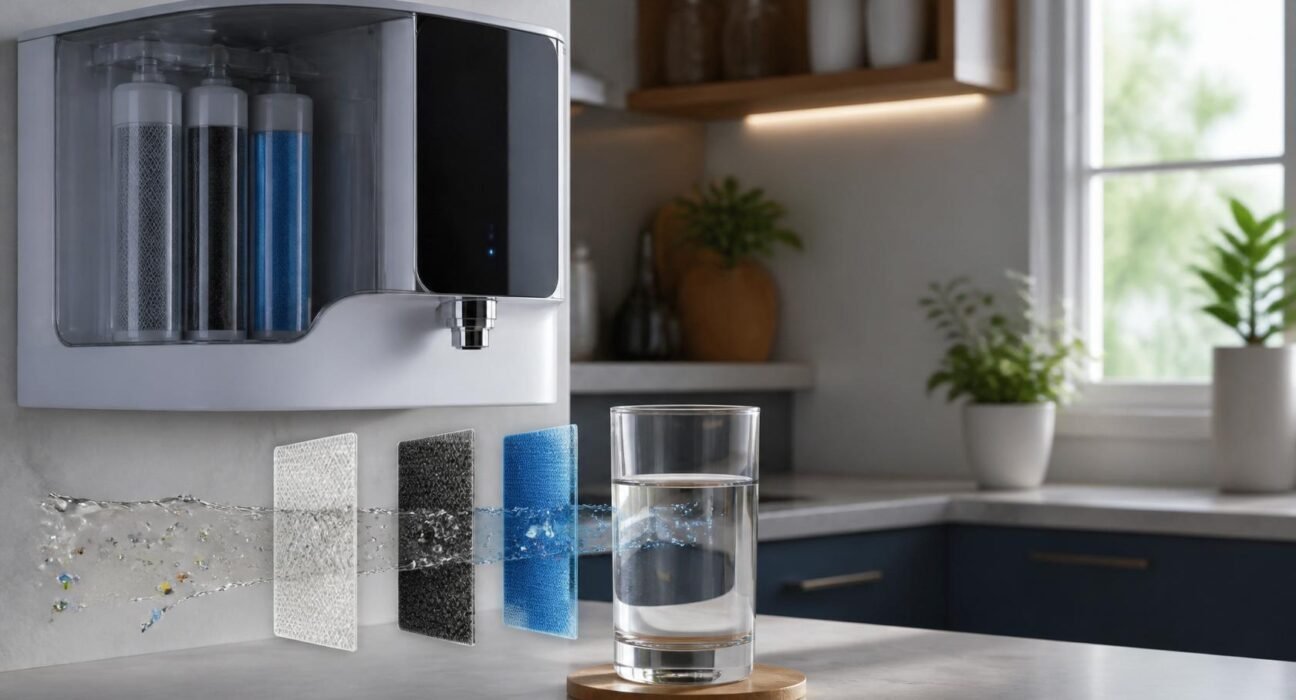
If you’re hunting for the best water purifier under ₹15,000 in India, your smartest bet is an RO+UV+UF combination from brands like Kent, Aquaguard, Livpure, or HUL Pureit. These models handle both high-TDS borewell water and municipal supply, and most come with multi-stage purification, decent storage capacity, and reasonable after-sales support.
This price bracket is genuinely competitive, with a wide range of features available without needing to spend significantly more. But the segment is also crowded with lookalike models, so knowing what actually matters — TDS handling, storage size, RO water purifier price versus long-term filter cost — makes the difference between a good buy and a regretful one.
Quick Answer
The best water purifier under ₹15,000 for most Indian homes is an RO+UV+UF purifier with 7-8L storage and TDS handling suited to your water source.
- Choose RO+UV+UF for TDS above 300 ppm or borewell/tanker water
- Choose UV+UF only for low-TDS municipal supply
- Pick 7-8L storage for most households
- Prioritize Kent, Aquaguard, or Livpure for service coverage
Why the Right Purifier Depends on Your Water Source
Not every home needs the same kind of purifier, and that’s where a lot of buyers go wrong. If you’re on municipal water supply with low TDS, a full RO system can strip out beneficial minerals unnecessarily and waste water in the process. On the other hand, if you’re dealing with borewell or tanker water — common across Indian suburbs and smaller cities — skipping RO is a mistake, since that’s usually where TDS and heavy metal levels are highest. A water purifier for borewell water without RO simply won’t handle the dissolved salts.
Water quality also isn’t static. It shifts with the seasons — monsoons bring turbidity and contamination risk, summers can concentrate dissolved solids as groundwater levels drop. So the “right” purifier really depends on testing your own water first, not just picking whatever’s trending online.
How to Choose a Water Purifier in 5 Steps
- Test your water’s TDS using a basic meter (widely available online for ₹200-500)
- Under 300 ppm → go with a UV+UF purifier (no RO needed)
- 300-2000 ppm → choose RO+UV+UF for complete protection
- Check storage capacity — 6-7L for small families, 8-10L for larger households
- Confirm service network coverage in your city before buying
Step-by-Step: Choosing the Best Water Purifier Under ₹15,000
Step 1: Understand Your Water Source
Borewell and tanker-supplied homes almost always need RO purification because dissolved salts and heavy metals don’t get removed by UV or UF alone. Municipal water, especially in metro areas, tends to have lower TDS but can carry bacterial contamination from aging pipelines — which is where UV and UF do the heavy lifting. Not sure where your levels stand? Here’s how to test and reduce TDS.
Step 2: Match Purification Technology to Your Needs
- RO (Reverse Osmosis): Removes dissolved salts, heavy metals, and high TDS content. Best for borewell or tanker water.
- UV (Ultraviolet): Neutralizes bacteria and viruses using UV light. Doesn’t reduce TDS.
- UF (Ultrafiltration): Physically filters out bacteria and cysts without electricity, adding another safety layer.
Most purifiers in this water purifier for TDS range combine all three, which is the safer default unless you’re absolutely certain your water is low-TDS municipal supply. For a fuller comparison, see this RO vs UV vs UF breakdown.
Step 3: Consider Storage Capacity and Flow Rate
For a 3-4 member household, 7-8L storage is generally sufficient. Larger families or homes that entertain often may want to look at 9-10L tanks. Flow rate (measured in litres per hour) matters too if your household uses a lot of water for cooking, not just drinking — note that storage capacity and daily usable output aren’t the same thing, so check both figures rather than storage size alone.
Step 4: Factor In Maintenance Cost, Not Just Purchase Price
This is where a lot of buyers get caught off guard. Some purifiers that look cheaper upfront end up costing more over 2-3 years because of frequent filter replacements. It’s worth asking about annual maintenance cost and filter life before finalizing.
Step 5: Check Brand Service Network
Kent, Aquaguard (Eureka Forbes), Livpure, and HUL Pureit have some of the widest service networks across Indian cities and towns, which matters a lot when a filter needs replacing or something goes wrong. If you plan to self-install, note that electrical and drain-line connections carry leak and shock risk if done incorrectly — professional installation (often included with purchase) is recommended to avoid this and to preserve your warranty.
Are Alkaline and Copper Add-Ons Worth It?
Some models in this price bracket include alkaline mineralizers (which balance the pH of RO-purified water, since RO tends to make water slightly acidic) and copper infusion cartridges. These aren’t essential, but if you’re already comparing two similarly priced models, this can be a reasonable tiebreaker — just don’t let it override the more important factors like TDS handling and service reliability.
Prevention Tips: Getting the Most Out of Your Purifier
- Test your water’s TDS every few months, since municipal supply quality can fluctuate seasonally
- Change external filters more frequently during monsoon months when water carries more sediment
- Don’t ignore low-storage or filter-change indicators — running a purifier past its filter life reduces purification efficiency
- Keep the unit away from direct sunlight and extreme heat to protect internal components
Frequently Asked Questions
Do I need RO if I already have municipal water supply?
Not always. If your TDS is under 300 ppm, a UV+UF purifier is usually enough. RO becomes necessary above that, or if your municipal supply is known to have contamination issues.
What’s the ideal TDS level for drinking water?
Under BIS IS 10500 guidelines, 500 ppm is the acceptable limit, with up to 2000 ppm permissible in the absence of an alternate source. The WHO does not set a health-based guideline value for TDS but notes water becomes unpalatable well below these levels — generally under 300 ppm is considered good for taste.
How often should I replace purifier filters?
This varies by model and usage, but most RO membranes last 1-2 years while pre-filters may need replacing every 3-6 months, especially during monsoon season.
Is alkaline water actually necessary?
It’s not essential for health, but it does help balance the pH of RO-purified water, which some users find improves taste.
Can I install a water purifier myself?
Basic installation is possible, but professional installation (often included with purchase) is recommended — it ensures correct pressure settings, safe electrical/drain-line connections, and warranty compliance.
If you’re still unsure which purifier fits your specific water conditions, feel free to reach out — we’re happy to walk you through the comparison based on your city and water source.

Leave feedback about this