
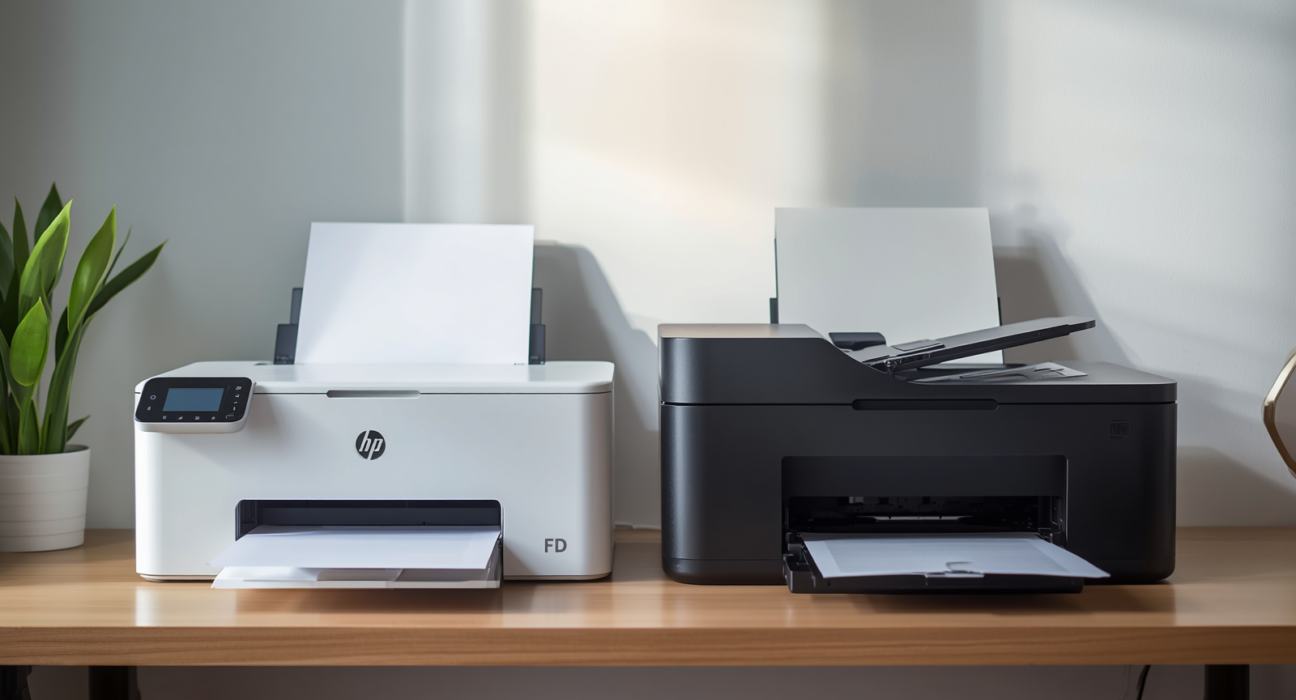
If you’re comparing an inkjet vs laser printer for home use in India, the short version is this: pick an inkjet (ideally an ink tank model) if you print photos or colour documents regularly, and pick a laser printer if you mostly print black-and-white text and want something that survives long idle periods without clogging. Your actual usage pattern matters far more than the price tag on the box.
Most first-time buyers get stuck comparing specs — print speed, resolution, page yield — without asking the one question that actually decides this: what am I going to print, and how often? Once that’s clear, the choice usually makes itself.
This guide walks through exactly how the two technologies differ, what they’ll cost you over time (not just on day one), and which one fits your specific situation, whether that’s a home office, a student’s desk, or a household that prints a school project once a month.
Quick Answer
Inkjet vs Laser Printer: Purchase Price vs Running Cost
The confusion usually comes from mixing up three different things: purchase price, running cost, and print quality. A printer that looks cheap on Amazon can end up being the expensive option once you factor in how much you’ll spend on ink or toner over two years. That’s the piece most buying guides skip, and it’s the one that actually matters.
There’s also a climate factor that’s specific to India and rarely mentioned in global comparisons. Humidity and dust genuinely affect printer reliability in ways global buying guides don’t account for — in humid regions, inkjet cartridges left unused for weeks are more prone to drying out or clogging, while laser printers tend to be more forgiving in these conditions. If your printer sits idle between uses, that alone can tip the decision toward laser.
Quick Fix: How to Decide in 3 Steps
- Check what you print most — mostly text (laser) or mostly colour/photos (inkjet).
- Estimate your monthly print volume — under 50 pages a month, either works; over that, running cost matters more.
- Think about idle time — if the printer will sit unused for weeks, favour laser or an ink tank inkjet over a cartridge-based one.
Step-by-Step: Inkjet vs Laser, Explained Properly
1. How they actually work
Inkjet printers spray tiny droplets of liquid ink onto the page to form text and images. Laser printers use a laser to charge a drum, which then picks up toner powder and fuses it onto the page using heat. This mechanical difference is the root of almost every practical difference between them — speed, running cost, and even how well they cope with India’s humidity.
2. Print quality
Inkjets, especially ink tank models, are genuinely strong for photos and colour graphics. They excel in producing high-quality prints with sharp colours and realistic details, often boasting resolutions up to 4800 x 1200 dpi, and they can print on a wider range of paper types and sizes, including borderless prints. Laser printers, on the other hand, are the better choice for crisp, professional-looking text — invoices, resumes, school assignments — with less smudging.
Curious why your prints are coming out wrong? See printer not printing in colour for common causes and fixes.
3. Running cost — the part that actually decides your total spend
This is where most buyers get caught out. A cartridge-based inkjet looks affordable upfront but can quietly become the most expensive option to own. Ink tank printers solve this by using refillable bottles instead of cartridges, and the cost difference is substantial: a colour cartridge on an old-school inkjet typically covers only a few hundred pages before needing replacement, while an ink bottle refill for a tank printer costs a fraction as much per bottle and lasts for thousands of pages. Always check current cartridge and bottle pricing for your specific model before buying, since this varies by brand and retailer.
Toner works differently but tells a similar story. Inkjet cartridges typically last a few hundred pages, while toner cartridges in laser printers commonly last 1,000–2,500 pages or more depending on the cartridge type, which is why laser printers are usually cheaper per page once you’re printing in volume.
4. Speed and volume
Laser printers are built for speed and consistency at scale. They’re the better fit if you’re printing dozens of pages regularly, such as for a small home office or a student printing study material often. Inkjets, including ink tanks, are perfectly fine for occasional or moderate printing but tend to be slower page-per-minute, especially in colour.
5. Reliability in Indian conditions
This is a genuinely underrated factor. In many cases, printers that sit unused for two to three weeks at a stretch — common in households that print only occasionally — are more prone to inkjet nozzle clogging, particularly during humid months. Laser printers don’t have this problem since toner doesn’t dry out the way liquid ink does.
Which Printer Is Better for Home Use? (By Use Case)
- Students and school projects: An ink tank inkjet works well here since school work often involves colour charts, diagrams, or printed images alongside text. The Canon PIXMA G3010 is a commonly recommended ink tank model for this exact use case. If budget is tighter and volume is low, a cartridge-based model like the HP DeskJet Plus 4123 (HP’s Ink Advantage line) is a cheaper upfront option, though running costs will be higher over time than a true ink tank printer.
- Home office, mostly documents: A monochrome laser printer is usually the smarter buy — lower cost per page, no clogging risk, and consistently sharp text for invoices and reports.
- Occasional home use with some photo printing: A mid-range ink tank inkjet offers the best balance — reasonable upfront cost, low running cost, and solid photo quality when you need it.
- Printer that’s rarely used, sits idle for weeks: Lean laser. It tolerates idle periods far better than any inkjet.
Advanced Tip: Total Cost of Ownership Over 2 Years
Before buying, don’t just compare box prices. Estimate: (cost of ink/toner refills you’ll realistically use per month) × 24 months, then add that to the purchase price. This single calculation is usually enough to flip the “cheaper” option into the more expensive one, especially with cartridge-based inkjets.
For specific model recommendations at this budget, see ink tank printers under ₹15,000.
Prevention Tips
- If you go with an inkjet, print something small at least once every couple of weeks to prevent nozzle clogging.
- Buy genuine ink or toner — refilled or grey-market supplies are a common cause of clogged heads and voided warranties.
- Check for a nearby authorised service centre before buying; a printer with no local support is a hassle down the line, regardless of specs.
- Keep your printer away from direct humidity exposure — near a window during monsoon season isn’t ideal for inkjets.
- If connectivity issues crop up after setup, see fix common printer connectivity issues for quick fixes.
FAQ
Q: Is an inkjet or laser printer better for home use in India?
A: For most homes, an ink tank inkjet offers the best overall value if you print occasionally and want colour. If you print mostly text in higher volumes, a laser printer is the more economical long-term choice.
Q: Which printer is cheaper to run — inkjet or laser?
A: Laser printers generally have a lower cost per page for black-and-white printing due to higher toner cartridge yields. Ink tank inkjets close this gap significantly for colour printing compared to traditional cartridge inkjets.
Q: Do laser printers work better in humid Indian conditions?
A: In many cases, yes. Toner doesn’t dry out the way liquid ink can, so laser printers tend to handle long idle periods and humidity better than standard inkjets.
Q: Can I print photos on a laser printer?
A: Laser printers can print colour, but inkjets — especially ink tank models — generally produce better photo quality and richer colour detail.
Q: Is an ink tank printer the same as an inkjet printer?
A: Yes, ink tank printers are a type of inkjet printer that use refillable ink bottles instead of cartridges, significantly lowering the cost per page. Not all inkjets are ink tank models, though — cartridge-based lines like HP’s Ink Advantage series are also inkjets, just without the refillable tank.
If you’re still unsure which model fits your specific budget and usage, you can reach out and we’ll help you narrow it down based on what you actually print.

Leave feedback about this